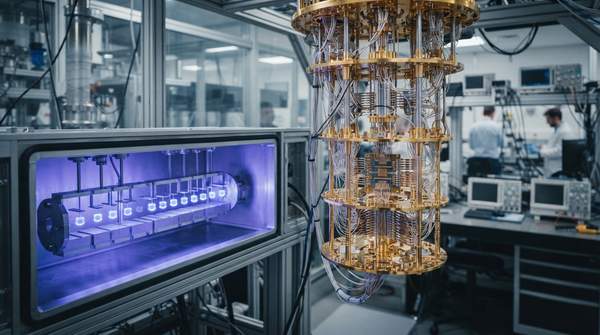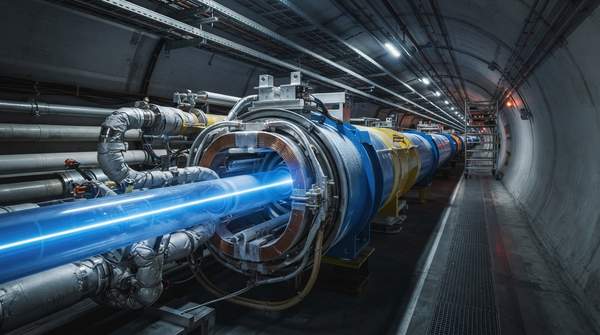
Superconducting magnets are what make a modern high-energy particle accelerator possible. In a machine like the Large Hadron Collider (LHC), thousands of them work in concert: dipole magnets bend the beams around the ring, quadrupole magnets squeeze the beams tight so they stay usable, and every one of them must be chilled to 1.9 kelvin—about ‑271.3°C, colder than outer space—to deliver the fields the physics demands.
The Role of Superconducting Magnets in Particle Accelerators
Why go to all this trouble? Left alone, accelerated particles travel in straight lines and drift apart. CERN explains that more than 50 types of magnets are needed to send them along complex paths without losing speed, and all of the magnets on the LHC are electromagnets.
The main dipoles generate fields of 8.3 tesla—more than 100,000 times stronger than the Earth's magnetic field—by pushing a current of 11,080 amperes through their coils. A normal conductor would dissipate enormous energy as heat at that current. A superconducting coil, as CERN describes it, allows the high currents to flow without losing any energy to electrical resistance.
The payoff is dramatic. CERN notes that if conventional magnets were used instead of superconducting magnets, the 27-kilometre LHC would have to be roughly 120 kilometres long to reach the same energy. Superconductivity is not a luxury here; it is the reason the machine fits in a tunnel at all.
Bending Particle Beams: Dipole Magnets
Dipole magnets are the workhorses that curve the beam. The LHC uses 1232 main dipoles, each 15 metres long and weighing about 35 tonnes. Their job is to bend the paths of the particles around the ring so that the beams can be brought into collision at the detectors.
The physics is straightforward in principle. A charged particle moving through a magnetic field experiences a deflecting force perpendicular to its direction of motion. To bend the beam uniformly, accelerator physicist Neil Marks's lecture notes for the Cockcroft Institute explain, a dipole must produce a field that is constant across the aperture—every particle in the beam then receives the same steering, so the whole bunch follows the same curved trajectory.
Stronger fields buy tighter turns. As CERN puts it, the powerful fields generated by the dipole magnets allow the beam to handle tighter curves, which is exactly what lets a high-energy machine stay compact.
Focusing Particle Beams: Quadrupole Magnets
Bending alone is not enough. A beam of charged particles naturally spreads, so it must be continually refocused or it will grow too diffuse to be useful. That is the quadrupoles' job.
The LHC carries 392 quadrupole magnets, each 5 to 7 metres long, which focus the beams. Unlike a dipole's uniform field, a quadrupole's field varies across its aperture. In the formalism Helmut Wiedemann sets out in his textbook on electromagnetic fields, quadrupoles together with bending magnets are the basic building blocks of beam transport systems, serving as focusing devices that keep the beam close to its desired path. The pole profile is shaped as a hyperbola, so the field strength grows with a particle's distance from the centre—particles that stray too far get pushed back toward the core.
The result is a tight, well-defined beam. And tight beams matter for the physics: when particles are bunched together, CERN points out, they are more likely to collide in greater numbers when they reach the detectors. Just before collision, yet another magnet type squeezes the particles closer still to raise the collision rate.
Superconducting Magnet Functions and Cryogenic Requirements
The table below maps each magnet type to its function and the engineering requirement that underpins it.
| Magnet type | Primary function | Physical action on beam | Key technology requirement |
|---|---|---|---|
| Dipole magnets (1232 in the LHC, 15 m long) | Bend the beams around the ring | Uniform field across the aperture applies a consistent steering force, curving every particle's path | Superconducting coil carrying 11,080 A to reach 8.3 T without resistive losses |
| Quadrupole magnets (392 in the LHC, 5–7 m long) | Focus the beams and prevent them from diverging | Field varies across the aperture, pushing straying particles back toward the beam core | Same superconducting coils and cryogenic cooling as the dipoles |
| All superconducting magnets | Enable high-energy acceleration in a compact ring | Stronger fields allow tighter turns than conventional magnets permit | Extreme cryogenic temperatures to eliminate electrical resistance |
| LHC magnet system as a whole | Keep beams stable and precisely aligned | Combined bending, focusing and final squeeze before collision | Cooled to 1.9 K (‑271.3°C) with superfluid helium |
Read this table as a division of labour: dipoles set the beam's direction, quadrupoles set its shape, and cryogenics makes both possible.
The Cryogenic Imperative: Why Extreme Cold Is Essential
Superconductivity has a catch: it only exists below a material's critical temperature. The most-used superconductor in accelerator magnets, niobium-titanium, has a critical temperature of just 9.2 kelvin, as CERN accelerator-school materials note. To carry enormous currents with zero resistance, the coils must therefore sit far below that point.
The trade-off is fundamental. Superconductivity implies zero electrical resistance, so no power is dissipated as Joule heating in the coils—but, as the same CERN course material observes, refrigeration power is needed instead, because known superconductors only work at cryogenic temperatures. The energy loss moves from the magnet out to the cooling plant.
That is why Berkeley Lab's Accelerator Technology & Applied Physics Division describes high-field superconducting magnets as particularly challenging and expensive to build and operate: the complex design, specialized materials and cryogenic cooling systems needed to maintain the superconducting state are inseparable from the technology itself.
Engineering the Cold: Cryogenic Systems in Accelerators
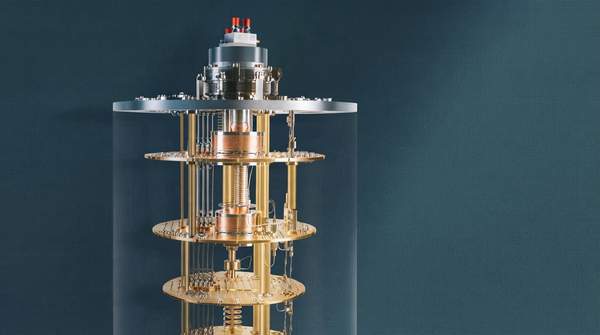
How do you hold a machine colder than outer space? In the LHC, the superconducting magnets are cooled to 1.9 kelvin using what CERN calls the world's largest cryogenic systems, chilling 23 kilometres of the accelerator's 27-kilometre circumference. Much of the accelerator is connected to a distribution system of liquid helium that cools the magnets.
The refrigerant of choice is superfluid helium, which CERN credits with very efficient heat-transfer properties—exactly what you need to pull heat out of thousands of magnets strung along kilometres of tunnel. The scale is the point: this is not a laboratory dewar but continent-scale infrastructure, and CERN counts the magnets among the most formidable technological challenges of the entire project.
Materials research continues to push on this frontier. Berkeley Lab is fabricating new quadrupole magnets from niobium-tin, a material that can sustain higher fields than niobium-titanium, and CERN's course materials note that niobium-tin is already being used in some magnets of the HL-LHC upgrade—though it is brittle and requires a high-temperature heat treatment after winding.
Ensuring Beam Stability Through Cryogenic Magnet Control
For accelerator operators, the lesson of all this engineering is simple: the magnets only work while they stay cold. Particle accelerator operators must continuously monitor and maintain the extreme cryogenic conditions of superconducting magnets to ensure stable and precise particle beam control. The measure to watch is a consistent operating temperature of 1.9 K (‑271.3°C) across the accelerator's magnet systems—held there by superfluid helium, that temperature is the single number on which the bending, the focusing and, ultimately, the collisions all depend.