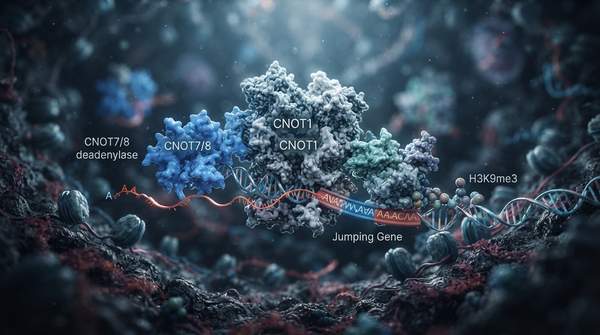
Nearly half of the human genome is made of remnants of "jumping genes," yet most of that DNA stays silent. New research from a Penn State team led by researcher Chintan Kulkarni identifies the CCR4-NOT protein complex as a previously unrecognized guardian in that system, and shows that it works in two distinct ways: it helps keep the genes that silence transposons active, and it directly controls the stability of the RNA that transposons produce when they do switch on. The finding, described in a preprint posted on bioRxiv and in Penn State's reporting on the work, has not yet completed formal peer review.
The Threat of Jumping Genes: Genomic Instability
Transposons are DNA sequences that can move within a genome, and retrotransposons do so by copying themselves through an RNA intermediary. The most abundant of these in mammals are LINEs — long interspersed nuclear elements. According to the preprint, nearly 20% of the human and mouse genomes consist of annotated LINE1 sequences, and because LINE1 activity amplifies other repeat elements such as SINEs, L1 activity may account for as much as half of mammalian DNA.
That abundance is only tolerable because the elements stay controlled. The preprint notes that inappropriate activation of LINE elements has been associated with genome instability, developmental defects, cancer, neurological problems and aging. As Quanta Magazine's Max Kozlov has reported, organisms take extreme measures to regulate transposon activity precisely because of dangers like genomic instability and harmful mutations. The question the Penn State work addresses is which molecular machinery performs that regulation in human cells — and how.
Introducing the CCR4-NOT Complex: A Genomic Guardian
The CCR4-NOT complex was previously best known as a controller of RNA. It is a multi-subunit assembly, and the preprint focuses on two of its core components, CNOT1 and CNOT4, which the authors found to have unique functions despite their opposite effects on messenger RNA stability. When the researchers depleted either subunit in human cells, transcription increased rapidly and widely across the genome — which the authors describe as the first evidence that human CCR4-NOT regulates transcription at all, not just RNA after the fact.
That genome-wide shift had a striking feature: inactivating CCR4-NOT activated LINE and other retrotransposon elements throughout the genome. In other words, a complex known for handling RNA turned out to be standing between transposons and their opportunity to move. Penn State's Sam Sholtis reports that the study demonstrated, for the first time, the role of the CCR4-NOT complex in suppressing jumping gene activity.