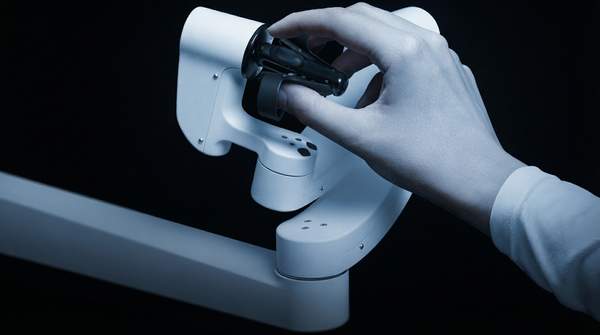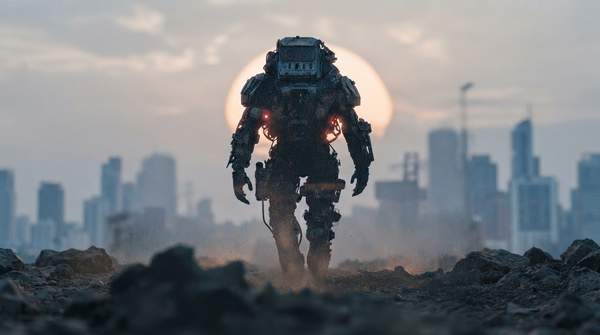
An $89,000 humanoid robot mingled with passersby in Brooklyn Bridge Park on Sunday, October 25, in what its maker, Faraday Future, described as an effort to learn how humans interact. Chief Technology Officer Hong Rao, who chaperoned the machine, told the New York Post that the robot was there to learn to "interact" and "nurture" — with the eventual aim of serving as a babysitter, teacher, or companion. The demonstration placed one of the most expensive consumer-facing robots yet seen in a public New York City space, and it offered a visible preview of a much larger robotics business the California company has been building.
Faraday Future's $89K AI Robot Debuts in NYC Park
The robot drew a crowd in the waterfront park, including a group of visitors from Argentina who gathered around it for photographs, according to the Post's on-scene reporting. Rao identified the machine as a Faraday Future design and confirmed its $89,000 price. The setting was deliberate rather than accidental: a public park full of unpredictable pedestrians is exactly the kind of unstructured environment that a robot intended for household and companion roles would need to navigate. On-scene accounts from the photographer covering the event also described the robot walking, singing, and dancing for onlookers.
What made the scene notable was not just the price tag but the company behind it. Faraday Future is best known as an electric vehicle maker, and the park appearance signals how far its ambitions have stretched beyond cars. The humanoid in the park is one piece of what the company calls its EAI Robotics ecosystem — a portfolio of machines it has assembled, by its own account, in under a year.
Learning Human Behavior: The Robot's Stated Mission
Rao's explanation framed the outing as a learning exercise. The robot, he said, is in learning and development stages and relies on real-world experiences with people — hence the decision to place it among ordinary park visitors rather than in a lab. The stated goal is that repeated human interaction would train the machine for roles the company envisions: babysitter, teacher, companion, and household assistant.
Reports from the demonstration named vision-language-action (VLA) models and a "World Model" as the underlying technologies, terms the company uses to describe how its robots perceive surroundings and translate that perception into movement and response. Faraday Future's own materials describe the logic in a simple loop: use cases shape each robot's form, forms generate data, and that data makes the shared "brain" smarter, which in turn empowers every other form in the lineup. The park outing fits that loop — public interaction is the data-generation step.
Beyond the Spectacle: Faraday Future's Broader Robotics Vision
The company's corporate materials present the humanoid as one node in a system it calls "One Brain, Multiple Forms." Faraday Future says it has brought together a "Robot World 2.0" platform spanning 24 EAI devices, built on what it describes as a "Four-Core Full-Stack AI" ecosystem. The business model, in the company's phrasing, is "light on four, heavy on four" — light on capital, assets, marketing, and sales, and heavy on product power, AI, real-world utility, and users.
Read against that strategy, the park demonstration was more than a publicity stunt, though it certainly functioned as one. A humanoid learning to nurture in front of news photographers is a high-profile showcase of the company's AI capabilities, aimed at drawing attention to a product line that extends well beyond a single machine. The company also markets its robots for industrial security and inspection — energy facilities, manufacturing, mining, tunnels, and large buildings — and for education, markets far removed from babysitting.
Faraday Future's EAI Robotics Ecosystem
The comparison below draws on Faraday Future's own launch materials to situate the park humanoid within the company's full robotics portfolio. It shows three distinct product tracks, each with different forms, buyers, and price points.
| Robot Type | Stated Purpose / Market | Example Models | Price Point |
|---|---|---|---|
| Humanoid robots | Learning human interaction; envisioned future roles as babysitter, teacher, companion, or household assistant | The humanoid demonstrated in Brooklyn Bridge Park | $89,000, as reported at the scene; the company lists an EAI robot line starting at $137,900 |
| Industrial quadruped robots | Security patrols and high-risk industrial inspection for energy, manufacturing, mining, tunnels, and large facilities | Aegis Classic (indoor and building patrols); Aegis Mega (large outdoor and high-risk tasks), with configurable payloads including thermal imaging, 360° cameras, and LiDAR | A compact 22-kilogram wheeled quadruped listed at $12,990, including a $3,000 skills package |
| Educational robots | K-12 and higher-education learning, from robotics beginners to youth developers, covering programming, AI practice, competition, and research | Robots offered through the EAI Robotics Education & Innovation Lab initiatives | Not stated in the materials reviewed |
The table makes the strategic picture clear: the humanoid is the attention-getting front of a business whose near-term revenue logic appears anchored in industrial patrol and inspection work, where robots take over high-frequency, night, and dangerous patrols, and in education. The company says partners can move from single-unit sales to a recurring operations business of devices, payloads, subscriptions, and maintenance — a service model that matters more to its economics than any one robot's price.
Unanswered Questions: Autonomy in Public Demonstrations
The most consequential detail in the Post's account was also the quietest: Rao was operating the $89,000 robot with a small remote control as he spoke. That leaves open the central question observers at the scene raised — how much of what the robot did in the park reflected autonomous decision-making, and how much was direct human piloting. The company's framing, that the robot was there to learn, does not by itself establish that it was acting independently while doing so.
The distinction matters for every role Faraday Future envisions. A machine marketed as a babysitter or companion would need to operate without a chaperone holding a controller, and nothing demonstrated on Sunday established that capability. The company says its platform supports autonomous patrolling and AI event recognition in its industrial line, but the humanoid's degree of independent operation in a crowd of pedestrians remains unverified by anything shown at the event.
The Future of Human-Robot Interaction: What's Next?
Faraday Future's public demonstration signals a strategic move to integrate "Physical AI" into everyday life, but the immediate next step for observers is to monitor for further details on the robot's operational autonomy and the results of its "learning" phase. The park outing established interest, price, and intent — not capability.
The measurable indicator to watch is an official announcement from Faraday Future detailing the outcomes of the public interaction data collection or the first commercial pilot deployment of the humanoid robot. Until then, the gap between a remote-controlled machine that sings in a park and an autonomous caregiver remains exactly that — a gap, and one the company has not yet closed in public view.