Artificial intelligence accelerates the discovery of new materials by replacing slow, manual, one-experiment-at-a-time research with an automated loop: machine learning screens enormous numbers of candidate compounds in software, robots physically synthesize the most promising ones, and the experimental results feed back to sharpen the next round of predictions. Researchers at IBM and ETH Zurich, writing in npj Computational Materials, describe this as a shift in which "traditional manual, serial, and human-intensive work is being augmented by automated, parallel, and iterative processes driven by Artificial Intelligence (AI), simulation and experimental automation." The practical payoff is that scientists can focus scarce laboratory time on a far smaller set of genuinely promising candidates.
The New Era of Materials Discovery
Why does discovering a new material traditionally take so long? The old workflow depends on human intuition, serial experiments, and trial-and-error refinement. Each hypothesis must be physically tested, and most candidates fail. That makes the process expensive in both time and labor.
The new paradigm changes the structure of the work itself. Instead of a lone researcher testing one material at a time, AI models, high-performance computing, and robotic automation run many candidates in parallel and iterate quickly on the results. The npj Computational Materials authors argue that these capabilities "enable the acceleration and enrichment of each stage of the discovery cycle"—not just one bottleneck, but the whole pipeline from prediction to physical product.
One caveat is worth stating up front: this acceleration applies to the discovery phase. Turning a validated new material into a manufactured, commercial product remains a separate challenge that this article does not cover.
The Three-Stage AI-Driven Discovery Pipeline
To make the process concrete, we can model modern AI-driven discovery as a three-stage cycle. This model is our synthesis of the published descriptions rather than a framework the sources name explicitly, but each stage is grounded in documented practice.
First, high-throughput computational screening uses machine learning to filter vast chemical spaces down to a shortlist of promising candidates. Second, autonomous synthesis and experimentation uses robotic laboratories to physically create and test those candidates without a human at the bench. Third, AI-informed validation and refinement compares the experimental outcomes against the original simulations, calibrating the models so the next screening cycle starts smarter than the last.
The crucial feature is that the pipeline is cyclical, not linear. Every physical experiment produces data that improves the computational models, which in turn improves the quality of the next shortlist. Discovery becomes a feedback loop rather than a straight line.
Stage 1: High-Throughput Computational Screening with Machine Learning
The core mechanism of acceleration is what researchers call the computational funnel. A traditional funnel starts with a huge pool of hypothetical materials and runs high-throughput virtual screening at successive levels, each level narrowing the pool further. As the npj authors explain, each level of the funnel is affected by two things: the accuracy of the screening and the computational cost of running it.
Machine learning attacks both constraints at once. The authors note that machine learning "has the ability to markedly improve both of these, if the right training data is available." A well-trained model can predict a candidate's properties in a fraction of the time a full physics simulation requires, and with better accuracy than cheaper approximate methods. That means the funnel can start wider and cut deeper before any physical experiment happens.
The scale of the gain can be striking. In one workflow described in the same paper, a multi-step AI refinement achieved a 100-fold reduction in the number of generated candidates that a human environmental toxicology expert had to analyze before selecting a few top candidates for automated retrosynthetic analysis. That example came from a specific chemical study—candidates built around a dialkylphenylsulfonium core, with (4-methylphenyl)dimethylsulfonium triflate used as a model surrogate for final validation—so the figure illustrates what the method can achieve rather than a universal constant. But the principle generalizes: fewer candidates reaching human hands means lower cost and faster decisions.
AI also helps close the gap between simulation and reality. The authors describe calibrating simulation outputs to better reflect experimental outcomes, so the shortlist that emerges from the funnel is more likely to survive contact with a real laboratory.
Stage 2: Autonomous Synthesis and Experimentation
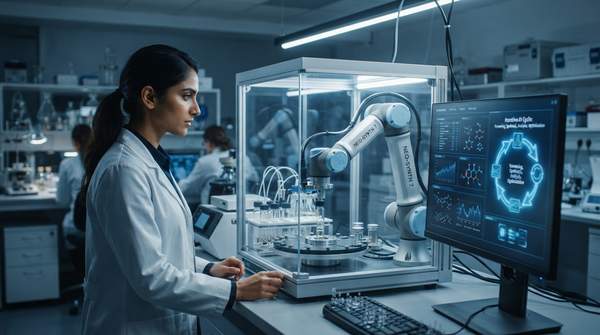
Screening in software only matters if promising candidates can be physically made. This is where autonomous laboratories enter the pipeline. Berkeley Lab's A-Lab, which launched in 2023, is a fully automated laboratory that uses robots guided by artificial intelligence to speed up materials science discoveries, according to the lab's news center.
The significance is not just robotic arms replacing pipettes. An autonomous lab can run experiments continuously, in parallel, and adjust its plan based on each result—mirroring at the bench the same iterative logic that machine learning provides at the screen. Since its launch, the A-Lab has collaborated with the Materials Project to synthesize novel materials with promise for future technologies.
For the researcher, this changes the job description. Instead of spending weeks attempting a single synthesis, scientists supervise an automated campaign that attempts many, and the failures become training data rather than wasted effort.
Stage 3: AI-Informed Validation and Refinement
The final stage closes the loop. When an autonomous lab synthesizes a candidate, the measured outcome—did it form, what structure did it adopt, does it have the predicted property—is compared against the simulation that motivated it. Discrepancies reveal where the models are weak.
Those results flow back into the screening models in two ways. They improve the raw training data available for machine learning, and they support the calibration of simulation outputs to reflect experimental reality. The next screening cycle therefore starts from a better-calibrated, better-informed model.
Interpretability research strengthens this stage further. Reporting from the Institute of Science Tokyo describes a method that extracts key features from an AI model trained on atomic structural data and optical absorption spectra, then groups materials with similar structural and spectral characteristics. Understanding why a model makes a prediction—rather than treating it as a black box—helps researchers trust, debug, and refine the funnel between cycles.
The AI-Driven Materials Discovery Workflow
The full cycle, from computational prediction to physical validation and back, looks like this:
- High-throughput computational screening. Machine learning models filter a vast pool of hypothetical materials through a computational funnel, improving both the accuracy and the cost of each screening level—provided the right training data exists. In one documented workflow, this refinement cut the candidates requiring expert human analysis by 100-fold.
- Autonomous synthesis and experimentation. The shortlist passes to a robotic laboratory such as Berkeley Lab's A-Lab, where AI-guided robots synthesize and test the candidates without manual bench work, running continuously since the lab's 2023 launch.
- AI-informed validation and refinement. Experimental outcomes are compared with the simulations, and the results—both successes and failures—calibrate the models and enrich the training data, so the next screening cycle begins with sharper predictions.
- Repeat. The refined models reopen stage one, making the entire process an iterative loop in which each cycle is faster and more accurate than the last.
Reading the workflow this way shows the essential point: computational prediction flows into robotic synthesis, and robotic results flow back to refine future predictions. No single technology produces the acceleration; the closed loop does.
Case Study: The Materials Project and Berkeley Lab's A-Lab
The clearest working example of this pipeline connects a data platform to an autonomous lab. The Materials Project, supported by the U.S. Department of Energy's Office of Science, provides curated, open-source datasets of simulated material properties. According to Berkeley Lab, those curated datasets position it as essential infrastructure for AI-powered materials design, and the platform continues to evolve its machine learning capabilities, with plans for enhanced computational methods and better handling of complex materials behavior.
The connection to physical experimentation is explicit. "One of the exciting areas that we've been working on is connecting this simulation pipeline to autonomous experiments carried out at Berkeley Lab's A-Lab," said Jain, a researcher quoted in the lab's account. "Not only are we simulating things in the computer, but we're also bringing new materials into reality."
This pairing demonstrates each stage of the model in action: the Materials Project's datasets train and inform the computational screening; the A-Lab's robots synthesize the candidates; and the collaboration's results, combined with what the lab describes as comprehensive data coverage, rigorous quality standards, and community-driven expansion, feed the foundation for accelerating discovery timelines for new materials with specific desired properties.
Accelerating Innovation: The Future of Materials Science
For research organizations and materials scientists, the decision is to embrace AI and automation to significantly reduce the time and cost associated with discovering and developing new materials. The evidence supports a specific mechanism: machine learning narrows the computational funnel—demonstrably cutting the candidates needing human analysis by 100-fold in one workflow—while autonomous labs like the A-Lab convert those shortlists into physical materials without serial manual labor.
The measurable indicator to watch is the increasing number of novel materials discovered and validated within shorter development cycles, as evidenced by academic publications and industry reports. The A-Lab's output since its 2023 launch, and the Materials Project's expanding machine learning capabilities, offer concrete benchmarks for whether the promised acceleration is being realized.
Sources
- Accelerating materials discovery using artificial intelligence, high performance computing and robotics -… — Nature
- Accelerating Discovery: How the Materials Project Is Helping to Usher in the AI Revolution for Materials Science — Berkeley Lab News Center
- Interpretable AI in materials discovery: Uncovering how models make predictions — Phys.org