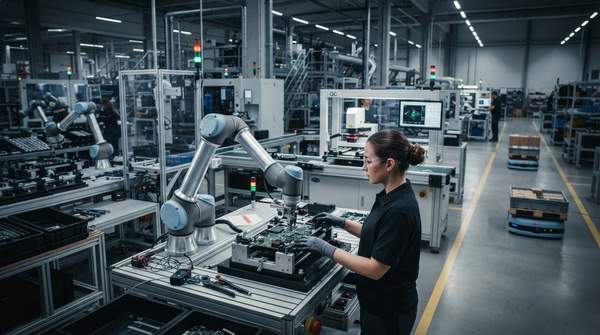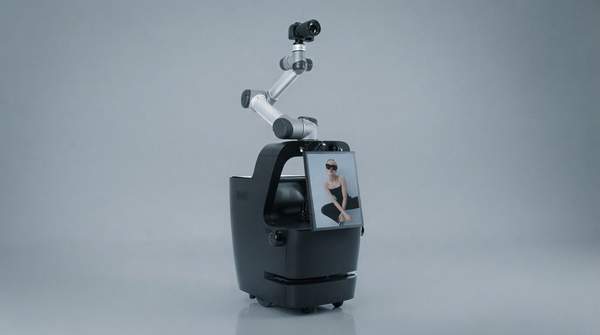
Robots anticipate the future with two distinct kinds of predictive AI. World Models act as a machine's imagination: they learn an internal, predictive picture of the environment and simulate what would happen if the robot took a particular action. Vision-Language-Action (VLA) models work differently. They act as the robot's brain, translating camera observations plus human instructions directly into executable motions. Understanding how these two model families differ—and how they can be combined—explains most of what is happening in modern predictive robotics.
The Robot's Perception-Prediction-Action Loop
How does a machine actually "think ahead"? The process can be broken into five causally linked stages, each feeding the next. The loop below is the core explanatory model for everything else in this article.
- Sensory input. Cameras and other sensors capture the current state of the environment—the objects, surfaces, and obstacles around the robot.
- Internal world representation. The robot builds a predictive model of the world from that data, assigning meaning and geometry to what it sees rather than treating it as raw pixels.
- Action simulation and prediction. The robot asks itself the question at the heart of world models: "What would happen if I do this?" It forecasts future states of the scene as consequences of candidate actions.
- Action selection. Predicted futures are compared, and the robot evaluates candidate actions before executing them—similar, as researchers describe it, to how a person might mentally rehearse a movement.
- Motor command execution. The chosen plan is translated into concrete commands—joint positions or motion chunks—carried out on the robot's hardware, after which the loop begins again from fresh sensory input.
This loop is what makes prediction useful rather than decorative. Because the robot can rehearse outcomes internally, it can avoid costly, risky, or time-consuming real-world interactions, as a survey of robotic manipulation puts it. The loop also explains where the two model families fit: world models dominate stages two and three, while VLA models compress the whole loop into a single learned mapping from observation and instruction to action.
World Models: Simulating Physical Reality
If vision models are a robot's eyes, a world model is its imagination. A world model is a generative AI system that learns an internal, predictive model of its environment, letting the robot simulate answers to "what if" questions before committing to a move. This gives machines a form of common-sense physical reasoning, which improves planning and decision-making.
A robotics survey frames the value in practical terms: world models let robots reason about future states, anticipate the consequences of actions, and perform evaluations—capabilities that matter most in real-world settings where interactions are costly, risky, or slow. Rather than physically trying every grasp, the robot can rehearse grasps in its imagination and discard the bad ones.
World models also vary in scope. A robotics survey indicates that the selection between single-task and multi-task world models is influenced by factors such as task complexity, generalization needs, available data, computational resources, and modularity, with multi-task models often favored for adaptable and reusable robotic systems. In other words, a world model is a design category, not a single algorithm.
Vision-Language-Action (VLA) Models: Bridging Language and Movement
VLA models solve a different problem: connecting human words to robotic deeds. They are trained to link natural-language commands with visual input and translate that combined understanding into executable motor commands. Instead of writing complex code, you can simply tell the robot what to do—"pick up the blue cup next to the laptop"—and the model works out the motions.
In state-of-the-art robotics applications, VLA models act as the brain of a robot. As MIT researchers describe the workflow, a VLA model processes environmental observations from the robot's camera and task instructions to generate a series of immediate motions, which it then executes on the robotic hardware. The prediction here is short-horizon and action-shaped: the model forecasts what the robot should do next, not a full video of the future scene.
World Models vs. VLA Models: A Comparative View
The clearest way to hold both families in mind is a side-by-side comparison.
| Dimension | World Models | VLA Models |
|---|---|---|
| Primary function | Simulate physical dynamics and environmental change; answer "what would happen if I do this?" | Translate human language plus visual input into executable actions |
| What they predict | Future states of the scene—consequences of candidate actions | The robot's next motions, output as a chunk of actions |
| Training basis | Internal predictive models of the environment | Datasets of images, text, and corresponding robot actions |
| Strength | Common-sense physical reasoning; evaluation before execution | Instruction following without explicit programming |
One distinction deserves emphasis: unlike some world models, VLAs do not explicitly generate future states. A VLA compresses perception and instruction into action; a world model renders the future itself. That difference shapes what each can and cannot be trusted to do.
Integrating Predictive Models for Complex Tasks
The two families are not rivals so much as complementary layers. Recent research shows how they can be unified or stacked. In one architecture described by researchers working on latent predictive planning, language instructions serve as the high-level action input that guides an internal rollout of predicted scenes, while a separate inverse dynamics module converts that rollout into low-level robot commands as absolute joint positions. High-level understanding steers the imagination; a control module handles the physics of execution.
Unified training is another route. A unified AI model reported by Mindplex, written by Giulio Prisco, was trained to understand instructions, predict future scenes, and generate actions together. In simulated tests it responded not only to direct commands like "Put the rose in" but also to indirect references such as "Put in the flower that symbolizes love." Because it can predict future scenes, the robot can evaluate candidate actions before executing them. The researchers also optimized for speed: by grouping action information and reusing computations, they achieved up to 29 times faster internal action generation compared with an unoptimized version.
Challenges and Future Directions in Predictive Robotics
The current limits are as instructive as the capabilities. Prevailing predictive models are primarily based on video generation—predicting sequences of 2D frames, sometimes augmented with depth and normals, from a single viewpoint. Because these models are inherently 2D and operate in pixel space, they produce physical inconsistencies with the real 3D world and limit accurate spatial understanding. The problem is sharpest in fine-grained manipulation, where accurate 3D cues are essential: objects can appear to pass through each other, and collision responses can come out wrong, because 2D video prediction does not inherently enforce 3D physical laws.
Generalization is the second open problem. Many real-world tasks, particularly mobile manipulation, cannot rely on fixed sensors and require observations from varying viewpoints. Models trained from fixed viewpoints struggle to generalize to novel viewpoints when simulating planning trajectories. Researchers report that structured 4D latent predictive approaches can preserve consistent 3D structure and object placement from unseen viewpoints, but viewpoint robustness remains an active research frontier rather than a solved property.
Navigating the Future: The Evolving Role of Predictive AI in Robotics
Robotics developers and researchers should continue to focus on improving the physical consistency of 2D video predictions and enhancing viewpoint generalization for predictive models. The measurable indicator to watch is improved real-world robot performance in complex, dynamic environments, evidenced by fewer physical inconsistencies and more robust operation from varied perspectives. Until those two gaps close, world models will keep imagining futures that occasionally break physics, and VLA models will keep acting without fully rehearsing what comes next. The robots that think ahead most reliably will be the ones that combine both: language to understand the goal, prediction to see the consequence, and action to close the loop.
Sources
- A Step Toward World Models: A Survey on Robotic Manipulation — ARXIV
- Making robots faster by helping them think ahead — MIT News | Massachusetts Institute of Technology
- Structured 4D Latent Predictive Model for Robot Planning — ARXIV
- Unified AI model lets robots understand instructions, predict scenes, and take action — Mindplex