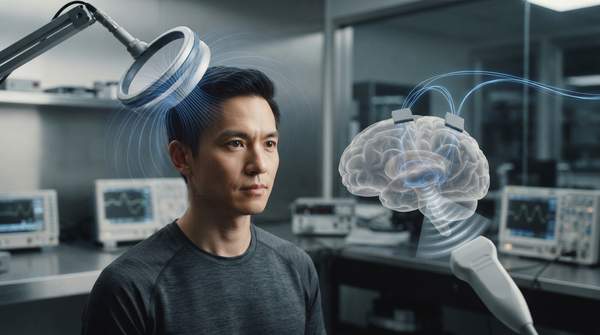
If you want to tell TMS, tDCS, tACS, and focused ultrasound apart, focus on three questions: what physical force does the technique use, which conditions is it used or studied for, and how precisely can it reach the brain region that matters? TMS uses magnetic fields to induce electrical currents, tDCS delivers a low direct current through scalp electrodes, tACS applies an alternating current, and transcranial focused ultrasound (tFUS) uses precisely targeted sound waves. Here is how those differences play out in practice.
Understanding Non-Invasive Brain Stimulation (NIBS)
Why do such physically different methods belong in one family? Because they share a biological goal. A review of NIBS techniques in Alzheimer's disease research states plainly that "the primary mechanism of action for NIBS-based interventions is their ability to induce lasting changes in synaptic plasticity in targeted circuits."
In other words, the point of stimulation is not the stimulation itself. It is the after-effect: nudging brain circuits so that they continue to function differently once the session ends. That is why researchers link these techniques to conditions like depression, chronic pain, anxiety, Parkinson's disease, and dementia, where the hope is a durable change in how neural circuits behave rather than a momentary one.
Keep in mind what this article is not. It is a general overview based on published research, not medical advice, not a clinical guideline, and not a protocol manual. We will not cover dosages, session frequencies, or the full range of NIBS techniques that exist beyond these four.
Transcranial Magnetic Stimulation (TMS)
How can you stimulate the brain without inserting electrodes? TMS sidesteps that problem by using physics. As Desarkar, Vicario, and Soltanlou explain in a Scientific Reports overview, TMS "utilizes magnetic fields to induce electrical currents in specific brain regions, allowing researchers to modulate neural activity with increasing precision."
A coil placed at the scalp generates a magnetic field, and that field in turn induces an electrical current in the cortex beneath it. Because the field is focal, the stimulated area is relatively circumscribed compared with techniques that pass current across the whole scalp. When pulses are delivered repetitively (rTMS), the effects on cortical excitability can outlast the session itself.
What is it used for? Reviews of the field describe TMS as investigated or applied for depression, chronic pain, anxiety, and Parkinson's disease. Repetitive TMS for treatment-resistant depression is the most established application, and a review of NIBS in Parkinson's disease included multiple rTMS variants—low-frequency, high-frequency, and deep TMS with an H-coil—in its comparison of motor-symptom interventions.
Transcranial Direct Current Stimulation (tDCS)
tDCS is the simplest of the four to picture: two or more electrodes on the scalp, a weak direct current flowing between them. The Scientific Reports overview describes it as delivering "low electrical currents through scalp electrodes, influencing cortical excitability." It does not directly trigger action potentials the way a strong induced current might; rather, it shifts the background excitability of the cortex, making neurons under the anode easier to fire and those under the cathode harder.
That subtlety comes with a trade-off. Because the current spreads through the scalp and skull before reaching the brain, tDCS is generally a broader, less spatially precise tool than TMS. A review of brain sensing and neuromodulation technologies lists tDCS among the electrical techniques that employ weak currents or magnetic fields to influence neuronal firing patterns, alongside TMS.
Condition-wise, tDCS has been investigated for chronic pain, anxiety, Parkinson's disease, and depression. It has also drawn attention in dementia research: a review examining NIBS in Alzheimer's disease lists tDCS among its focal techniques, while noting that its efficacy in that condition is still under review rather than settled.
Transcranial Alternating Current Stimulation (tACS)
tACS is tDCS's sibling with a different waveform. Instead of a steady direct current, it delivers an alternating current—oscillating between positive and negative—through scalp electrodes. Its distinctive aim is to interact with the brain's own rhythms: by matching the frequency of endogenous brain oscillations, tACS is used in research to study and try to modulate those oscillations.
Its role in the clinical literature is still emerging. The Parkinson's disease network meta-analysis by a research team comparing NIBS techniques included tACS alongside tDCS, TBS variants, and other electrical methods as interventions for motor symptoms. And in the basic-science literature, a Frontiers study led by Yasuto Inukai compared tACS and tRNS (transcranial random noise stimulation) for increasing cortical excitability, finding that tRNS showed more power across time points than tACS.
One honest caveat from that same Frontiers work: the physiological mechanisms by which transcranial electrical stimulation generates cortical excitability are not completely understood. tACS sits at the frontier where the tool is well defined but the biology beneath it is still being mapped.
Focused Ultrasound (tFUS)
Focused ultrasound is the outlier of the four, because its energy is acoustic rather than electromagnetic. A review of brain sensing technologies describes ultrasound neuromodulation as utilizing "precisely targeted sound waves to stimulate brain tissue," and notes that it "offers exceptional precision and can access deeper brain regions, holding potential therapeutic applications for conditions such as Alzheimer's, epilepsy, and stroke."
That combination—depth plus precision—is what sets tFUS apart. Scalp electrodes and magnetic coils largely act on the cortex near the surface; focused sound energy can be steered toward structures deeper in the brain. Recent work by Eleanor Martin and colleagues, published in Nature Communications, demonstrated an ultrasound system designed "to induce lasting plasticity in deep brain structures and their associated networks," which the authors describe as opening new avenues for studying neural adaptation and developing therapeutic interventions.
In psychiatry, tFUS remains an actively investigated method rather than a routine clinical one. A review of transcranial focused ultrasound in psychiatry catalogs early evidence, including studies of how sonication of specific regions relates to functional connectivity changes—such as reported increases between subgenual anterior cingulate cortex sections and other brain regions after tFUS but not after sham.
Comparative Overview of Non-Invasive Brain Stimulation Techniques
The table below juxtaposes the four techniques across the three criteria that matter most: how each one works, what it targets, and what kind of tool it is. Reading across the rows, you can see why they are not interchangeable—each pairs a distinct physical mechanism (magnetic, electrical, or acoustic) with a different balance of precision and depth.
| Technique | Mechanism of Action | Primary Target Conditions | Key Characteristics |
|---|---|---|---|
| Transcranial Magnetic Stimulation (TMS) | Magnetic fields induce electrical currents in specific brain regions, modulating neural activity | Depression (most established), chronic pain, anxiety, Parkinson's disease | Focal stimulation with increasing precision; lasting excitability effects attributed to cumulative pulses and sessions acting on synaptic plasticity |
| Transcranial Direct Current Stimulation (tDCS) | Low direct electrical current delivered through scalp electrodes, influencing cortical excitability | Chronic pain, anxiety, depression, Parkinson's disease; Alzheimer's disease under review | Non-invasive and simple; generally less spatially precise than TMS |
| Transcranial Alternating Current Stimulation (tACS) | Alternating electrical current applied through scalp electrodes, interacting with brain oscillations | Investigated for Parkinson's motor symptoms and other disorders; largely a research tool | Non-invasive electromagnetic technique; physiological mechanisms for generating cortical excitability not fully understood |
| Focused Ultrasound (tFUS) | Precisely targeted sound waves stimulate brain tissue | Studied for Alzheimer's disease, epilepsy, stroke, and psychiatric applications | Exceptional precision; can reach deeper brain regions and induce lasting plasticity in deep circuits |
Two patterns stand out from this comparison. First, the electrical techniques (tDCS, tACS) trade spatial precision for simplicity and broad cortical coverage, while TMS buys greater focality through its magnetic mechanism. Second, focused ultrasound is the only one of the four whose physical properties allow both high precision and access to deep brain structures—which is precisely why it is the emerging technique to watch in conditions, like Alzheimer's and epilepsy, that involve circuits well below the cortical surface.
Choosing the Right NIBS Technique for Research or Therapy
The practical decision, whether you are reading a study or weighing a therapy, is to distinguish between NIBS techniques by considering their specific mechanism of action, the depth and precision required for the target brain region, and the condition being addressed. TMS is the most clinically established of the four, particularly for depression. tDCS offers the simplest hardware for broad cortical modulation. tACS is the tool of choice when the research question is about brain rhythms, with the caveat that its underlying physiology is still being worked out. Focused ultrasound is the deep-circuit option, with exceptional precision but a still-maturing evidence base.
A useful measurable indicator that you have absorbed this comparison: you should be able to look at any NIBS study headline—on depression, Parkinson's, or Alzheimer's—and correctly identify which technique is involved and why its mechanism suits the target region, based on its unique profile. That skill transfers directly to reading the next wave of results in this fast-moving field.
Sources
- MDPI
- Non-invasive brain stimulation in research and therapy - Scientific Reports — Nature
- Comparative motor effectiveness of non-invasive brain stimulation techniques in patients with Parkinson’s… — PMC
- Non-Invasive Brain Sensing Technologies for Modulation of Neurological Disorders - PMC
- Frontiers | Comparison of Three Non-Invasive Transcranial Electrical Stimulation Methods for Increasing…
- Ultrasound system for precise neuromodulation of human deep brain circuits - Nature Communications
- Transcranial Focused Ultrasound Neuromodulation in Psychiatry — PMC