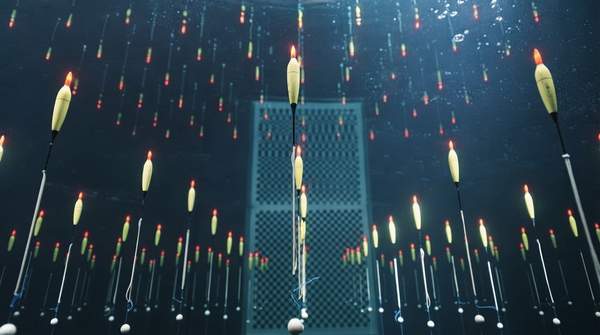
An international team has used a neutrino telescope resting 2,450 metres beneath the Mediterranean Sea to test one of the foundational principles of Einstein's theory of relativity—and found no violation. On November 4, 2026, the KM3NeT collaboration published an analysis of 5,828 atmospheric neutrino events in the Journal of Cosmology and Astroparticle Physics, setting new experimental limits on how far the laws of physics could deviate from Einstein's framework.
Deep-Sea Experiment Challenges Einstein's Laws
The experiment, called KM3NeT/ORCA, sits about 40 kilometres off the coast of Toulon, France. Its full name—Oscillation Research with Cosmics in the Abyss—signals its mission: studying neutrinos produced when cosmic rays strike Earth's atmosphere. The detector is still under construction, and the new result comes from just its first six detection units.
Why put a particle detector on the seabed? The researchers wanted to test Lorentz invariance, the principle that the laws of physics are the same everywhere in the universe. As the collaboration explains, verifying this does not require traveling to distant galaxies—installing sensitive light sensors on the floor of the Mediterranean is enough.