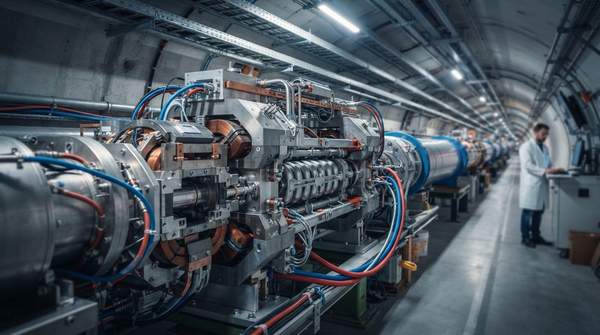
A particle accelerator works by taking tiny particles such as protons or electrons, boosting them to high energy with electric fields, keeping them on course with magnetic fields, smashing them together or into a target, and recording what comes out. That is the whole machine in one sentence. From there, accelerators come in two basic shapes—straight and circular—and the choice of shape shapes the kind of experiment a machine can run. Here is how each piece of the process fits together, based on how the laboratories that build these machines, such as Brookhaven National Laboratory, describe their operation.
Introduction to Particle Accelerators
Why would physicists go to the trouble of building machines kilometers long? Because matter does not give up its secrets gently. To see what is inside an atom, or inside the particles inside an atom, you need to hit it hard enough that it breaks apart in a controlled way.
Accelerators supply that controlled violence. The IAEA, whose knowledge portal covers accelerator science and its applications, describes accelerators as a core tool of nuclear research, producing ion beams used across both science and industry. The physics logic is simple: the more energy packed into a collision, the finer the detail you can probe, and the heavier the particles you can create from the collision's energy.
CERN, which began as a European council for nuclear research in the early 1950s, notes that its main field has since shifted from the nucleus to particle physics as a whole—today the laboratory is often called the European Laboratory for Particle Physics. That shift captures why accelerators matter: they are the microscopes of the subatomic world.