Nobody knows what dark matter is made of. That single fact explains why physicists do not rely on one experiment to find it. Instead, they pursue four distinct strategies at once: direct detection, indirect detection, collider searches, and axion searches. Each targets a different hypothesis about what dark matter might be, how heavy it could be, and how it might show itself. Understanding how these four approaches differ—and why they need each other—is the key to making sense of one of the biggest research programs in physics.
The Elusive Universe: Why Dark Matter Demands Diverse Searches
Why not just pick one method and perfect it? Because dark matter's basic properties remain unknown, and the range of possibilities is enormous. As the U.S. Department of Energy explains, dark matter interacts very weakly—or almost not at all—with the ordinary matter that we and our measuring instruments are made of. The one clear exception is gravity: dark matter exerts gravitational attraction, just like ordinary matter does.
That near-invisibility is the central problem. A particle that barely interacts with anything is a particle that barely leaves a trace. And the candidate particles differ wildly in scale. The Department of Energy notes that WIMPs (weakly interacting massive particles) would have 1 to 1,000 times the mass of a proton, while the axion would be ten-trillionth the mass of an electron. A third possibility is a rich, complex set of particles forming a so-called Dark Sector—a universe parallel to our own.
A particle ten trillion times lighter than an electron cannot be hunted with the same tools as a particle a thousand times heavier than a proton. A scientific review of direct-detection experiments adds a further complication: comparing results across different detection methods is, in general, model dependent. No single experiment can rule out every possibility on its own, which is precisely why the field spreads its efforts across complementary strategies.
Direct Detection: Feeling the Invisible Touch
The most intuitive strategy is to wait for a dark matter particle to bump into ordinary matter. Direct-detection experiments aim to detect massive dark matter particles via their scattering in a detector medium, according to the review of direct-detection experiments. If a dark matter particle passes through and occasionally strikes an atomic nucleus, that nucleus recoils—and the experiment measures the recoil.
Why go to all this trouble? Because the payoff would be enormous. Measuring this scattering process would provide information on the dark matter particle's mass and its interaction probability with ordinary matter—two of the most basic unknowns in the field. The review emphasizes that identifying the nature of dark matter would answer one of the most important open questions in physics and help us better understand the universe and its evolution.
The leading target for this approach is the WIMP, the candidate whose mass range sits comfortably within what a nucleus-scattering experiment can probe. A prominent example is the LUX-ZEPLIN (LZ) experiment, a liquid xenon-based detector operating nearly a mile underground at the Sanford Underground Research Facility in Lead, South Dakota, as described by the Department of Energy. The underground location is not a stylistic choice: it helps shield the detector from cosmic rays and other background noise that could mimic a genuine signal. When you are searching for an almost-never event, you must make sure nothing else can fake it.
Indirect Detection: Tracing Cosmic Annihilations
Rather than catching dark matter directly, indirect detection looks for the aftermath of dark matter interactions happening out in space. The strategy is to search for the observable byproducts that dark matter processes might leave behind, using instruments that watch the sky rather than detectors buried underground.
The direct-detection review treats indirect detection as one of the three complementary approaches alongside direct detection and collider searches. Its distinctive strength is reach: it does not require dark matter to wander into a laboratory detector. Whatever dark matter is doing throughout the galaxy, an indirect search can, in principle, observe the consequences across cosmic distances.
The trade-off mirrors that of all astrophysical observation: you cannot control the conditions. The signals an indirect search depends on must be distinguished from ordinary astrophysical processes, and interpreting what is seen requires assumptions about how dark matter behaves in space. That is why the review stresses that comparisons between indirect results and other methods are model dependent—each approach answers to a different set of assumptions.
Collider Searches: Creating Dark Matter in the Lab
Instead of waiting for dark matter to come to us, collider searches try to make it. Since the Large Hadron Collider (LHC) at CERN started operating in 2008, the CMS and ATLAS experiments have searched for new particles in proton-proton collisions, according to the direct-detection review. The idea is simple in outline: if you smash protons together hard enough, you might produce a dark matter particle directly.
How would experimenters see an invisible particle? The detection relies on observing missing energy or momentum in the collision products—energy that has apparently escaped the detector, presumably carried off by undetectable dark matter particles. This approach is sensitive to dark matter particles that can be produced at accelerator energies, which defines both its strength and its limit: a collider can only find what it can make.
So far, the results obtained at the LHC are consistent with standard model expectations, the review reports, but further searches will be performed in the coming years. The derived bounds can be translated into limits on the interaction cross-section for a given particle mass, and accelerator bounds are most constraining below roughly 5 GeV for spin-independent interactions and up to a few hundred GeV for spin-dependent proton couplings. A Fermilab-hosted seminar series on experimental methods similarly describes how accelerator experiments probe sub-GeV dark matter, with facilities such as Belle II and LDMX pursuing these searches over the coming years.
Axion Searches: Hunting for a Feather-Light Particle
Axions are a distinct candidate particle for dark matter—and a completely different kind of target. While WIMPs are heavier than a proton, the axion is astonishingly light: ten-trillionth the mass of an electron, per the Department of Energy's explainer. A scattering experiment built to catch heavy WIMPs is simply the wrong instrument for something this featherweight, which is why axion hunting is its own discipline.
The search exploits a predicted conversion. In theory, axions would convert into a particle of detectable light—a photon—in the presence of strong magnetic fields. That predicted behavior is what makes an ultralight, nearly invisible particle searchable at all: you do not catch the axion itself, you catch the photon it becomes.
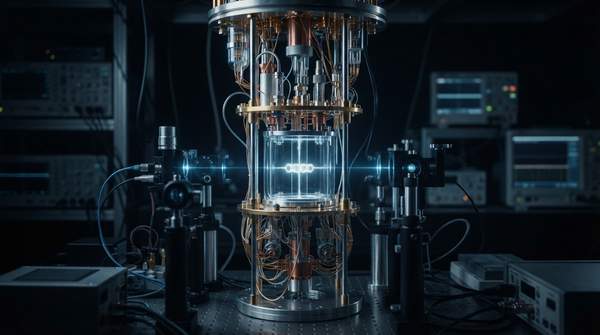
The Axion Dark Matter Experiment (ADMX) is a prominent experiment specifically designed to search for axion dark matter. According to a Fermilab seminar summary by Gianpaolo Carosi of Lawrence Livermore National Laboratory, advances in quantum sensing have enabled new limits on axion dark matter and opened prospects for detecting higher-mass axion-like particles with ADMX. In other words, this search is not static—improved detector technology is steadily widening the range of axion properties that can be tested.
Comparing Dark Matter Detection Strategies
The table below categorizes and contrasts the four approaches by their physical mechanism, target particle type, and representative instrumentation. Read it as a map of the search: each row occupies territory the others cannot easily reach.
| Detection Strategy | Detection Principle | Target Particle(s) | Example Experiment(s) |
|---|---|---|---|
| Direct Detection | Observes dark matter particles scattering off atomic nuclei in a detector medium; measures mass and interaction probability | WIMPs (1–1,000 times a proton's mass) | LUX-ZEPLIN (LZ) at the Sanford Underground Research Facility |
| Indirect Detection | Searches for observable byproducts of dark matter interactions in space | Dark matter candidates whose interactions leave observable traces | Sky-watching instruments (telescope-based searches) |
| Collider Searches | Produces dark matter in high-energy collisions; inferred from missing energy or momentum in the collision products | New particles creatable at accelerator energies | CMS and ATLAS at the LHC; Belle II and LDMX for light dark matter |
| Axion Searches | Converts axions into detectable photons in strong magnetic fields | Axions (ten-trillionth an electron's mass) | ADMX |
The comparison makes the division of labor visible. Direct detection waits for a recoil in a shielded underground detector. Indirect detection watches the sky for the consequences of dark matter interactions. Colliders manufacture candidate particles and notice what is missing when they escape. Axion searches convert an ultralight particle into light. No single row covers the others' territory, and none of them is designed to.
A Unified Front: Why Complementary Strategies are Key
The direct-detection review puts the rationale plainly: although it focuses on direct experiments, a comparison to collider searches and indirect detection experiments is beneficial due to the complementarity of the approaches. Each method constrains dark matter from a different angle, and together they cover far more of the possibility space than any one could alone.
The review also shows how the approaches interlock in practice. Collider bounds are most constraining in specific mass ranges, and translating those bounds into statements about other experiments is model dependent—so the methods genuinely probe different assumptions. Within direct detection itself, different interaction channels such as spin-dependent and spin-independent interactions can be exploited to constrain dark matter's properties further, and a detected annual modulation in the event rate could even yield information about the dark matter mass. The review notes one more subtlety: a certain degeneracy in interpreting results can only be broken if the dark matter mass is of the same order as the target nucleus.
In short, physicists hedge their bets because they must. With the particle's mass spanning from a fraction of an electron to a thousand protons, and its interaction type still unknown, four imperfect nets beat one. The strategies are not competitors; they are a coordinated search whose pieces check and refine one another.
The Ongoing Quest: A Multi-faceted Approach
Physicists will continue to pursue a diverse array of experimental strategies to detect dark matter, adapting approaches as new theoretical models emerge or experimental sensitivities improve. The evidence supports that expectation on every front: the LHC results so far are consistent with standard model expectations, but further searches will be performed in the coming years; accelerator experiments such as Belle II and LDMX are extending the hunt to light dark matter; and quantum-sensing advances are expanding what ADMX can test.
The measurable indicator to watch is continued funding and development of new and existing direct, indirect, collider, and axion search experiments, alongside publications of new results or refined exclusion limits. Those publications are how the field records progress even without a discovery: each refined limit shrinks the space where dark matter can hide. The hunt ends not when one strategy succeeds alone, but when one strategy's signal can be confirmed by another—and until then, every refined limit is a measurable step forward.
Sources
- DOE Explains...Dark Matter — Energy.gov
- Dark matter direct-detection experiments — ARXIV
- ASTRO