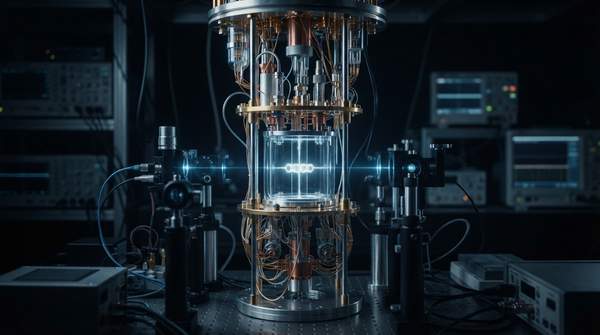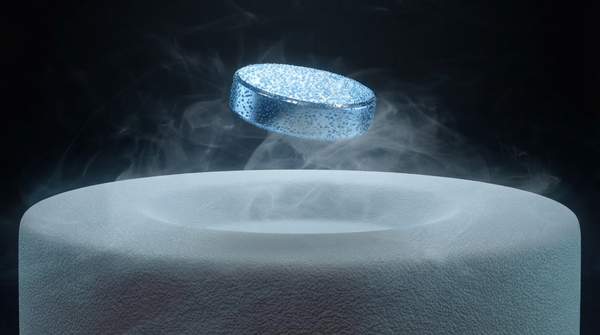
Quantum materials are substances whose macroscopic behavior is governed by quantum mechanical effects that cannot be approximated by classical physics. In a review in Nature Physics, condensed matter physicists Bernhard Keimer and Joseph Moore define the field by its members: superconductors, graphene, topological insulators, Weyl semimetals, quantum spin liquids, and spin ices. What unites them is that quantum effects remain manifest over a wide range of energy and length scales, producing properties ordinary materials cannot match—electricity carried without loss, or conduction confined to a surface that cannot be switched off by defects.
Understanding why these materials behave this way comes down to two ideas: strong electron correlation and topology. We will unpack both, then classify the major material classes and connect their physics to the technologies researchers expect them to enable.
What Defines a Quantum Material?
All materials are ultimately quantum at the atomic level—quantum mechanics describes how atoms bond and electrons interact. So why does the label "quantum material" exist at all? The distinction, as Keimer and Moore explain, is that in these systems quantum effects stay visible at macroscopic scales rather than washing out into a classical average.
Two structural features recur across the family. Many quantum materials derive their properties from reduced dimensionality, particularly the confinement of electrons to two-dimensional sheets. And their electrons often cannot be treated as independent particles; instead they interact strongly and give rise to collective excitations known as quasiparticles. In every case, quantum-mechanical effects fundamentally alter the material's properties.
The U.S. National Science Foundation frames the payoff plainly: quantum materials harness unusual quantum effects to produce properties not found in ordinary materials, which could enable next-generation technologies like quantum computers, advanced sensing, and ultra-secure communications. That framing—unusual properties flowing directly from quantum mechanics—is the working definition researchers use.
The Fundamental Quantum Concepts: Electron Correlation and Topology
Strong electron correlation means the electrons in a material cannot be described one at a time. In ordinary conductors, each electron is treated as an independent particle moving through a fixed background. In correlated materials, electrons behave collectively, and their interactions produce quasiparticles—collective excitations that act like new kinds of particles. Keimer and Moore note that this collective behavior leads to complex phase diagrams and states that are harder to describe classically than conventional ordered states like ferromagnetism.
Topology is a different kind of idea. In mathematics, topology describes properties that remain unchanged under continuous deformation—stretching or bending without tearing or gluing. In materials, as a review by Rajat Kumar Goyal and colleagues in the Journal of Materials Science explains, topology refers to properties of the electron states that are robust against disorder. The field took shape after the 1980 discovery of the integer quantum Hall effect opened the study of topological quantum states.
The practical consequence matters more than the abstraction. Because topological features cannot be removed by small perturbations, surface states protected by topology survive impurities and defects. That robustness is what makes topological materials attractive for electronics: the conduction is built into the material's structure, not its perfection.
Comparative Overview of Key Quantum Material Classes
The table below classifies representative quantum materials by their quantum mechanism, defining property, and application focus. The two classes with the strongest evidence across all dimensions—high-Tc cuprate superconductors and 3D topological insulators—are compared in full; the remaining rows show other archetypal classes compiled by CASRAI from peer-reviewed sources.
| Material Class | Example | Primary Quantum Mechanism | Defining Property | Primary Application Focus |
|---|---|---|---|---|
| High-Tc Cuprate Superconductor | YBa2Cu3O7 (YBCO) | d-wave Cooper pairing in strongly correlated CuO2 planes | Zero electrical resistance below the critical temperature (93 K for YBCO) | Lossless power transmission and high-field magnets |
| 3D Topological Insulator | Bi2Se3 (bismuth selenide) | Z2 topological invariant and spin-momentum locking | Insulating bulk with conducting, topologically protected surface states | Spintronics and dissipationless edge channels |
| Weyl Semimetal | TaAs (tantalum arsenide) | Broken inversion symmetry yielding chiral Fermi arcs | Weyl fermion-like electron states | Ultra-high mobility electronics and chiral optics |
| Kitaev Quantum Spin Liquid Candidate | alpha-RuCl3 | Bond-dependent anisotropic exchange; fractionalized Majorana excitations | Disordered magnetic state without conventional order (below ~7 K) | Topological quantum computing |
| Moiré Superlattice | Twisted bilayer graphene (1.1°) | Flat electronic bands from moiré superlattice potential | Tunable correlated phases (below ~3 K) | Tunable quantum phase simulators |
Reading the table this way shows the field's logic: each class is defined by which quantum effect dominates. The cuprate is a correlation story—electrons pairing through d-wave symmetry in strongly correlated copper-oxide planes. The topological insulator is a topology story—an insulating bulk whose surface must conduct because of the material's invariant. The distinction explains why the two classes point toward different technologies: correlation-driven superconductivity promises lossless current, while topology promises conduction that survives disorder.
One caution on "high-Tc": the term is relative. Cuprates discovered in 1986 still hold the record for the highest superconducting transition temperature under ambient pressure, and their superconducting properties appear only below that critical temperature. YBCO's 93 K is above liquid nitrogen's 77 K, which is what makes these materials experimentally convenient—hybrid devices can be investigated above liquid-nitrogen temperature, as researchers studying topological-insulator–superconductor hybrids have noted.
Transformative Applications of Quantum Materials
Quantum materials hold potential for various future technologies, including advanced sensing for medical breakthroughs , more powerful and energy-efficient computing , enhanced secure communication systems , and more efficient methods for energy generation, storage, and transmission .
Quantum computing is the most prominent target. Hybrid structures of topological insulators and superconductors are an active research area precisely because of the possibility of detecting Majorana modes—quasiparticles that could encode information in a way that is intrinsically protected from noise . The Kitaev spin-liquid candidate alpha-RuCl3 is pursued for the same reason: its fractionalized excitations are the proposed raw material for topological quantum computing .
Spintronics and low-power electronics follow from the topological side. Because a topological insulator's surface states lock an electron's spin to its momentum, its surface conduction is robust against non-magnetic impurities—dissipationless transport that could carry information with minimal energy loss . The Goyal review adds that van der Waals quantum materials hold promise for electronic devices, quantum computing, and optoelectronics, while Princeton's materials institute lists faster computers, fault-tolerant quantum computers, improved optical sensors, and levitating trains among the technologies these materials could enable.
These are research directions, not products. The applications depend on overcoming challenges in synthesis and stability, and no source here supports specific commercial timelines.
The Quantum Age: A Future Shaped by Materials
The decision this evidence supports is clear: ongoing research and development in quantum materials are critical for advancing next-generation technologies across multiple sectors. The physics is genuinely different by class—correlation and topology produce distinct properties—and the classification above is the map for telling them apart.
The measurable indicator to watch is continued announcements of breakthroughs in material synthesis, device prototypes, and increased investment in quantum materials research. Since the U.S. National Quantum Initiative Act passed in 2018, the NSF has expanded its quantum materials investments through programs like the Quantum Leap Challenge Institutes and the National Quantum Virtual Laboratory. Those programs, and the peer-reviewed results they produce, are where the next class-defining discovery will surface.
Sources
- The physics of quantum materials - Nature Physics
- Engineering materials for the quantum age — NSF - U.S. National Science Foundation
- Exploring quantum materials and applications: a review - Journal of Materials Science: Materials in Engineering — SpringerLink
- Quantum Materials: Physics, Classes & Lab Guide — CASRAI
- Coulomb blockade effects in a topological insulator grown on a high-Tc cuprate superconductor - npj Quantum Materials — Nature
- YouTube post
- Investigations of proximity-induced superconductivity in the topological insulator Bi2Te3 by microRaman spectroscopy… — PMC
- Materials