
Mars
6 articles
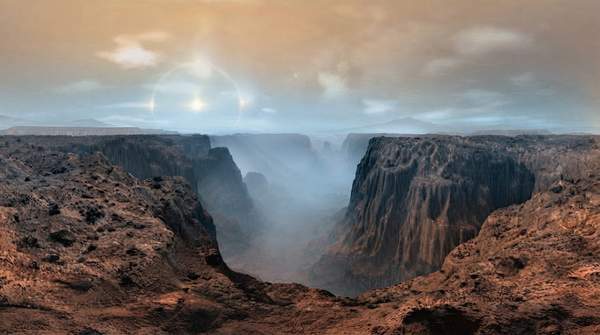
Three Ways to Build a World: Why Mars Rips, Venus Blisters, and Icy Moons Flex
Earth's unique plate tectonics are contrasted with the geological activity of Mars, Venus, and icy moons, driven by differences in internal heat and lithospheric structure. Understanding these comparative tectonic systems reveals diverse planetary evolution across our solar system.
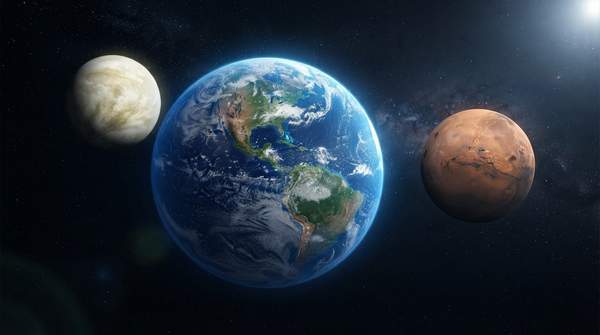
Beyond the Goldilocks Zone: Why Earth Thrives While Mars and Venus Failed
The popular "Goldilocks zone" is an incomplete measure of planetary habitability. Earth thrives due to a complex interplay of stellar, planetary, and geological factors, unlike Mars and Venus, which failed despite their orbits.

Phobos: Rapid orbit, asteroid-like characteristics
Mars' moon Phobos bears a massive impact crater, a cosmic scar so severe it nearly shattered the moon.

Blue Origin rebuilds pad as Relativity targets 2026 Mars
While Blue Origin rebuilds its New Glenn launch pad after a June explosion, Relativity Space and Impulse Space are already targeting 2026 for their first commercial robotic Mars lander mission.

Scientists detect potential signs of life on distant exoplanet
Despite headlines celebrating the detection of dimethyl sulfide on the distant exoplanet K2-18b, a recent survey reveals astrobiologists are actually more persuaded by potential biosignatures found in

Plasma beam tech could revolutionize Mars laundry
A purple plasma beam reduced spore colonies on cotton fabric from 250,000 colonies per milliliter to about 60,000 in recent tests, according to New Scientist .