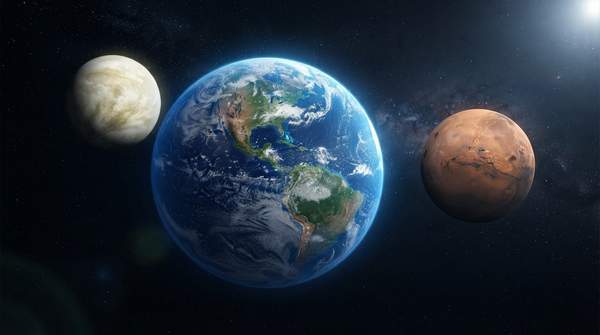
What makes a planet habitable? The popular answer is the "Goldilocks zone"—the distance from a star where water neither boils nor freezes. But that answer is incomplete. As planetary scientists Victoria Meadows and Rory Barnes put it, whether an exoplanet can maintain surface liquid water "is due to a complex interplay of planetary, stellar, and planetary system characteristics over the planet's lifetime." Our own solar system proves the point: Earth, Mars, and Venus all sit near the Sun's habitable zone, yet only Earth remains habitable today. Here is the multi-factor model that explains why.
Beyond the Goldilocks Zone: A Multi-Factor View of Habitability
NASA defines the habitable zone simply: the distance from a star at which liquid water could exist on an orbiting planet's surface. That definition works because, as far as we know, all life requires liquid water. So habitability, in the strict sense used throughout this article, means the potential to support life as we know it.
But the zone is only a starting point. NASA's Goddard Space Flight Center frames habitability as "the complex interplay between its host star, its own orbit and rotation, and the make-up of its surface and interior." A planet can sit in the zone and still be dead—airless, frozen, or cooked. The zone tells you where to look; the other factors tell you what you'll find.
Stellar Influence: The Star's Role in Planetary Fate
The host star does more than set the orbital distance where water stays liquid. Sara Seager's review of exoplanet habitability notes that small, dim stars have habitable zones much closer in than Sun-like stars, because their lower luminosity means less warmth at any given distance. Move the planet closer, and the star's behavior matters more.
NASA's Sellers Exoplanet Environments Collaboration warns of a specific hazard: planets orbiting stars that produce high levels of X-ray and ultraviolet flux from flares and activity "could end up stripped of their atmosphere, leading to a planet that may be warm but completely airless." In other words, even a perfectly placed orbit cannot compensate for a star that steadily erases a planet's air.