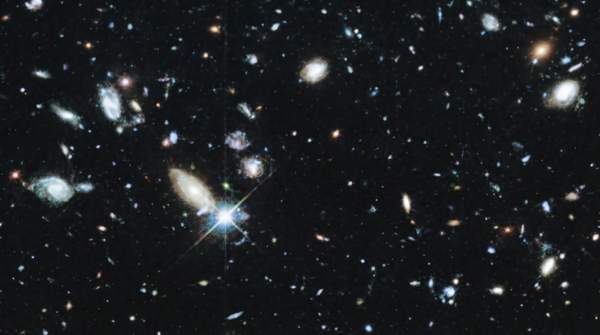
Cosmic inflation was proposed because the standard Big Bang model, on its own, cannot explain two striking features of our universe: why regions that were never in causal contact have almost exactly the same temperature, and why space is so remarkably flat. In 1980, physicist Alan Guth offered a way out: a burst of extremely rapid exponential expansion in the universe's first fraction of a second. Here is how the two problems arise, and how inflation resolves them.
The Standard Big Bang Model: A Universe of Mysteries
Why did cosmologists need to add anything to the Big Bang at all? The standard model describes a universe that expanded and cooled from an extremely hot, dense early state. As it cooled, particles formed, then atoms, then stars and galaxies. That broad picture works well. But the model has a deeper weakness.
As an EBSCO research summary puts it, the standard model handles its puzzles "by simply assuming the specific initial conditions necessary to account for the present observed features of the universe." Those assumptions have no theoretical basis, which makes them arbitrary. A good physical theory explains things; it does not assume them. The Center for Astrophysics at Harvard & Smithsonian makes the same point in its own words: the Big Bang "cannot self-consistently explain its own initial conditions." Two of those assumed conditions became famous problems.