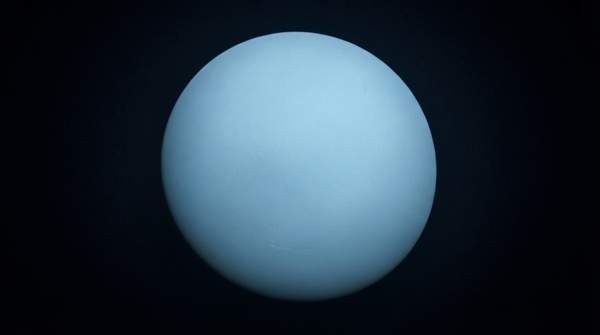
Uranus and Neptune look like twins, but planetary scientists increasingly suspect they are not. Three leading models now compete to explain the ice giants' histories: an outward migration model in which Neptune's building blocks formed closer to the Sun, a Nice-model scenario in which the two planets swapped orbits, and a giant impact hypothesis built to account for Uranus's sideways spin. Each tackles a different piece of evidence, and none has won. Here is how they compare, and why a future Uranus mission may settle the question.
The Ice Giants: Puzzles of Formation
Why are Uranus and Neptune so hard to explain? Start with the standard picture. In the core accretion model, planets grow slowly at large distances from a star, because the solid surface density is lower and planetesimals accrete at a much smaller rate. A review of Uranus and Neptune's origin and internal structure notes that this slow growth is exactly what the standard model predicts at the ice giants' orbital distances — making it difficult to account for two such massive planets so far out.
Then there is the chemistry. Models developed with contributions from Southwest Research Institute suggest the protoplanetary disk's volatile compounds condensed into chemically distinct reservoirs at different distances from the young Sun. Neptune's inferred composition does not fit the reservoir at its current location. "Neptune's chemistry is difficult to reconcile with the idea that it formed where we see it today, pulling from the same reservoir of cosmic materials as Uranus," said Olivier Mousis, whose team simulated the disk conditions that produce planetary carbon-to-oxygen ratios.
Finally, there is the tilt. Uranus rotates on its side, at roughly 97 degrees of obliquity, and testimony summarizing the 2023–2032 Planetary Science Decadal Survey describes this extreme axial tilt — possibly along with the rings and satellites — as a major puzzle that a primordial giant impact may explain. Any credible formation story has to face all three problems at once.
Model 1: Outward Migration
The first model rewrites Neptune's address. Scientists traditionally assumed both planets formed from materials in their immediate cosmic neighborhoods. But the SwRI-led modeling points elsewhere for Neptune: its building blocks likely condensed closer to the young Sun, where the disk's chemistry matched what we infer today, and then migrated outward before Neptune accreted them.
This model's strength is composition. If Neptune assembled from volatile-rich solids that condensed in a warmer, chemically distinct zone, its present chemistry stops being an anomaly. Uranus, by contrast, can plausibly have formed in roughly its current vicinity from the local reservoir.
The trade-off is that the model suggests distinct evolutionary paths for two superficially similar worlds. "Two superficially similar worlds may have reached their present locations and formations through two very distinct evolutionary paths," Mousis said. The migration model answers the composition puzzle directly, but it does not by itself explain Uranus's tilt — and Mousis cautions that without in-situ access to both atmospheres, our understanding of their composition, interiors and formation remains fundamentally limited.
Model 2: The Nice Model and an Orbital Swap
A second idea comes from dynamical studies of early solar system migration. Decadal Survey testimony notes that it is unclear when and where Uranus formed — and that it may have swapped positions with Neptune during early migration. In this Nice-model-style scenario, the two planets we see today did not necessarily form in the order or places we observe now.
An orbital swap would carry consequences far beyond the ice giants. The same testimony emphasizes that such migration would have significantly affected the inner solar system, including the early Earth at the time when life may have been emerging. That makes the question relevant to more than outer-planet specialists.
The swap scenario is attractive because it decouples formation location from present location, easing the mass and composition puzzles. But it remains a possibility rather than a settled finding, and it still leaves Uranus's extreme obliquity unexplained without an additional event.
Model 3: The Giant Impact Hypothesis
The third model addresses the tilt head-on. Simulations of Uranus and Neptune's accretion, published by researchers confronting different giant impact scenarios, find that the planets' inclined rotation axes suggest giant impacts during their formation histories. Simulations of collisions among planetary embryos of roughly five Earth masses — with near-unity impactor mass ratios — can broadly match the planets' current masses, final mass ratio and obliquity.
There is a catch. Because of angular momentum conservation, planets produced in these impacts tend to rotate too fast compared with the real Uranus and Neptune. One proposed fix invokes collisions between objects of very different masses, such as a 13-Earth-mass proto-Uranus struck by a one-Earth-mass embryo.
Separate high-resolution simulations reported by EarthSky add a striking detail: an oblique impact on Uranus can tilt its spin axis and eject enough material to form a disk, some of it massive and rocky enough to explain Uranus's regular satellites. The tilt is a puzzle, and giant impacts are a proposed solution — not a proven cause. The impact model explains obliquity well but says less about why Neptune is more massive or chemically distinct.
Comparative Overview of Ice Giant Formation Models
To see how the pieces fit, compare each model against the three core puzzles. The table below maps each hypothesis to the observational evidence it primarily addresses, and flags where it falls short.
| Formation Model | Core Hypothesis | Explains Mass Difference? | Explains Composition Difference? | Explains Axial Tilt? |
|---|---|---|---|---|
| Outward Migration | Neptune's building blocks condensed closer to the young Sun and migrated outward; Uranus formed near its current location. | Not directly addressed | Yes — Neptune accreted material from a chemically distinct inner reservoir | No |
| Nice Model (Orbital Swap) | Uranus and Neptune may have swapped positions during early solar system migration. | Partially — formation location is decoupled from present location | Partially — different formation zones implied | No |
| Giant Impact | Collisions with planetary embryos shaped both planets; an oblique impact tilted Uranus. | Partially — simulations broadly match current masses and mass ratio | No | Yes — oblique impacts reproduce the tilt and satellite-forming disks |
| In-situ Formation (baseline) | Both planets grew from local material at their present distances. | No — core accretion predicts slow growth at large distances | No — Neptune's chemistry resists a shared local reservoir | No — the 97° tilt is unexplained |
The pattern is clear: no single model covers all three puzzles. Migration and orbital-swap scenarios handle where the planets and their materials came from; the impact hypothesis handles how Uranus ended up on its side. That is why many scientists treat the models as complementary pieces of one history rather than mutually exclusive rivals.
The Future of Ice Giant Exploration
How do we choose between these stories? The Planetary Society argues the only way to know is to send a mission to the ice giants. The 2023–2032 Planetary Science Decadal Survey, produced by the U.S. scientific community to guide NASA missions, recommends a Uranus spacecraft as the highest priority.
If commissioned, the Uranus Orbiter and Probe would measure the planet's complex magnetic field, map gravity variations, and probe its atmospheric wobbles to determine whether it has a fuzzy core and what that core is made of. An atmospheric probe would precisely measure gases and their relative abundances — exactly the compositional data the migration model needs. NASA's mission concept documents describe UOP as a Flagship-class mission developed in response to the Decadal Survey, noting that only one spacecraft has ever explored Uranus, thirty-five years ago.
The Next Frontier: Resolving Formation Mysteries
Future space missions to Uranus are essential for gathering the observational data needed to resolve debates between competing formation models. The decisive test is the launch and data return of missions like the Uranus Orbiter and Probe, specifically measurements of Uranus's gravity, magnetic fields, and atmospheric composition. Until those numbers arrive, the migration, orbital-swap and giant-impact models remain the best — and unresolved — explanations we have for two deceptively similar worlds.
Sources
- Uranus and Neptune: Origin, Evolution and Internal Structure — ARXIV
- SwRI staff contribute to new ideas about origins of Uranus, Neptune — EurekAlert!
- Democrats Science
- Accretion of Uranus and Neptune: confronting different giant impact scenarios — ARXIV
- Why Neptune and Uranus are different | Space — EarthSky | Updates on your cosmos and world
- How Uranus and Neptune are key to unlocking how planets form — The Planetary Society
- Science