Dark energy is the name scientists gave to the unknown phenomenon that is making the universe expand faster and faster. It is not a force anyone has measured directly. Its presence is inferred from how the cosmos behaves on the largest scales. The discovery came in 1998, when observations of distant exploding stars showed the universe is not slowing down under gravity's pull, but speeding up. The leading explanation—the cosmological constant—fits the data, yet it carries a theoretical discrepancy of roughly 120 orders of magnitude, making it one of physics' deepest unsolved puzzles.
What is Dark Energy?
Here is the puzzle in its simplest form. The universe has been expanding since the Big Bang, and gravity, from all the matter it contains, should tug against that expansion over time. For decades, the open question was whether gravity would slow the expansion forever or stop it entirely.
Instead, measurements revealed the opposite. As NASA's Hubble team explains, the expansion of the universe is speeding up, "faster and faster, propelled by some force we still don't understand." That mystery component is what we call dark energy. The U.S. Department of Energy notes that this extended period of cosmic acceleration began about 9 billion years after the Big Bang and continues today, and that the discovery earned the 2011 Nobel Prize in Physics.
Crucially, dark energy is not directly detectable. The Euclid Consortium, which runs a space mission designed to study it, emphasizes that its presence can only be inferred from the observation of large-scale structure and its dynamics. Its nature, origin, and composition remain mysterious.
The Cosmic Revelation: Evidence from Supernovae
The evidence came from an unlikely tool: exploding stars. Astronomers use a special class called Type Ia supernovae, which give off a consistent, known amount of light when a certain type of star explodes. Because their true brightness is fixed, these supernovae act as cosmic yardsticks—compare the known brightness to how bright they appear, and you can calculate their distance.
By the late 1990s, scientists knew the universe had enough matter to slow the expansion and had measured the expansion's current rate. The remaining task was to measure how much it had been slowing. As NASA recounts, "Or so they thought. What astronomers discovered was that the universe isn't slowing at all."
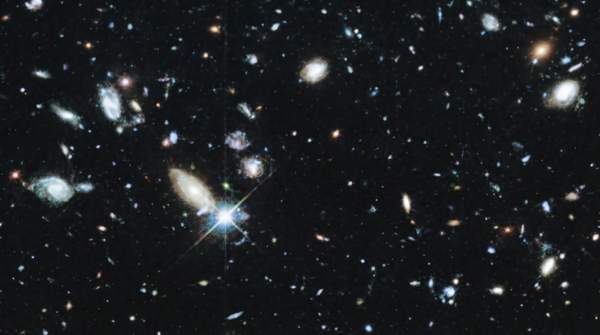
When astronomers analyzed the spectra of distant Type Ia supernovae, they could determine each object's redshift—how fast it was receding from us. The supernovae were dimmer, and therefore farther away, than a slowing universe would predict. Something was overcoming gravity and pushing space apart.