The "Goldilocks Zone" is a useful starting point, but it is an incomplete model of habitability. The traditional habitable zone asks only one question: is a planet at the right distance from its star for liquid water to survive on its surface? Modern astrobiology asks several more. A planet's potential to support life depends on a web of interdependent factors, including internal heat sources, geological activity, and the characteristics of its host star. Here is how those factors connect.
Beyond the Goldilocks Zone: A Broader View of Habitability
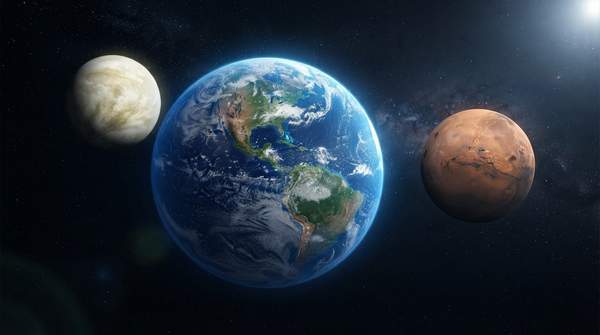
The habitable zone is defined by the possibility of sustaining liquid water on a planetary surface. At its inner edge, stellar light trapped by greenhouse gases boils off a planet's water; at its outer edge, the star's light is insufficient even with atmospheric help, and water freezes. In our Solar System, a conservative climate model places this band roughly between the orbits of Earth and Mars.
Scientists describe this distance-based screen as a first-order assessment. As one characterization review puts it, the initial judgment can be made from three observable characteristics: a planet's mass or size, the type of star it orbits, and its distance from that star. But the same review notes that as astrobiology develops, it is becoming clearer that multiple factors, characteristics, and processes determine whether a planet can actually acquire and maintain liquid water.
Why does distance alone fall short? Consider Earth and the Moon. They receive the same amount of stellar radiation, yet their surface environments are decidedly different, because Earth has an atmosphere and the Moon does not. An atmosphere is a necessary condition for surface liquid water, since water remains stable as a liquid only within a narrow range of temperatures at a given pressure. And atmospheres are not free gifts from orbital geometry—they must be built and maintained by planetary processes.