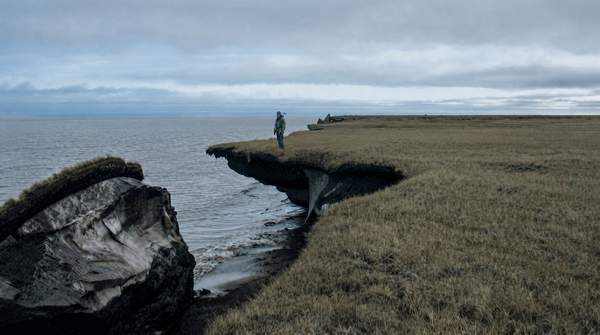
Permafrost thaw is not merely a consequence of global warming — it is a mechanism that multiplies it. Frozen Arctic ground holds an immense reservoir of organic carbon, estimated by NOAA's Arctic Report Card at 1,460 to 1,600 billion metric tons, and a separate NOAA-supported study puts the figure at roughly 1,700 gigatons. As rising temperatures thaw that ground, once-dormant microbes decompose the ancient organic matter and release carbon dioxide and methane into the atmosphere. Those gases trap more heat, which thaws more permafrost. Understanding this self-reinforcing cycle is essential to understanding why the Arctic is shifting from a region that slowed climate change to one that may now be fueling it.
The Arctic's Frozen Carbon Reservoir
Permafrost is ground that remains frozen year-round, and for hundreds to thousands of years it has been quietly doing the planet a favor. According to NOAA's Arctic Report Card, the Arctic region historically accumulated carbon in its soils and vegetation, acting as a net sink of atmospheric carbon dioxide. Dead plants, animals, and other organic material were locked into the frozen ground faster than they could decay, because cold temperatures suppressed the microbes that would normally break them down.
The result is a vast, frozen bank account of carbon. NOAA's report card estimates that permafrost soils contain between 1,460 and 1,600 billion metric tons of organic carbon — roughly twice the amount currently circulating in the atmosphere. A study partially supported by NOAA's Climate Program Office, published in Nature Climate Change by Chris Hope of the University of Cambridge and Kevin Schaefer of the National Snow and Ice Data Center, uses a comparable figure of about 1,700 gigatons of carbon stored as frozen organic matter. The estimates differ in detail, but they agree on the essential point: the permafrost reservoir is enormous, and it has begun to thaw in response to Arctic warming over the past few decades.
The Mechanism of Permafrost Thaw and Greenhouse Gas Release
The transformation from frozen vault to greenhouse gas source begins with temperature. As the Arctic warms, ground that has been frozen for centuries or millennia begins to thaw. Once thawed, the organic matter is no longer inert — it becomes food. Microbes that were dormant or sluggish in the cold wake up and begin decomposing the ancient plant and animal remains, a process NOAA's report card describes as faster microbial decomposition of permafrost carbon.
That decomposition releases two gases. In oxygen-rich, drier thawed soils, microbes primarily produce carbon dioxide. In waterlogged, oxygen-poor conditions — such as thawing ground that collapses into wetlands or lakes — microbes produce methane, a far more potent heat-trapping gas. As the NOAA-supported study puts it, as permafrost degrades, carbon dioxide and methane are released, amplifying the effects of emissions from human activity. The gases drift into the atmosphere, where they add to the warming that started the process in the first place.